Updated November 4, 2026
Parking etiquette comes down to one idea: park so everyone else can still park, get out of their car and get on with their day. That means staying inside the lines, leaving door room, and never blocking driveways, hydrants or reserved spots. It matters because small lapses cause real headaches: arguments, door dings, blocked-in neighbors and, sometimes, a tow truck. This guide covers the unwritten parking rules for lots, garages and residential streets, plus what to do when someone breaks them, including how to reach a driver when all you know is the license plate.
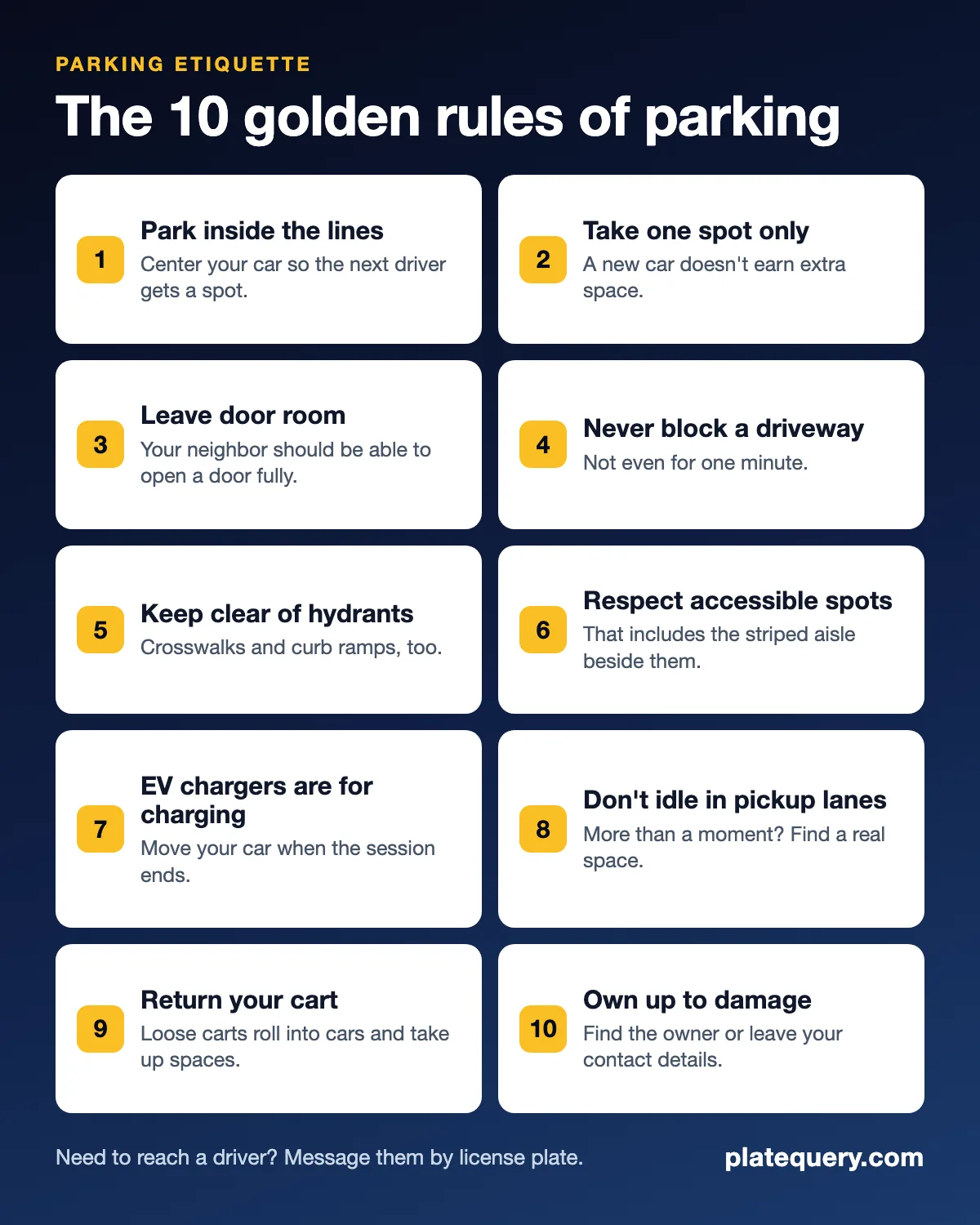
The golden rules of parking etiquette
Most of these aren't laws. They're the habits that keep a full lot from turning into a shouting match.
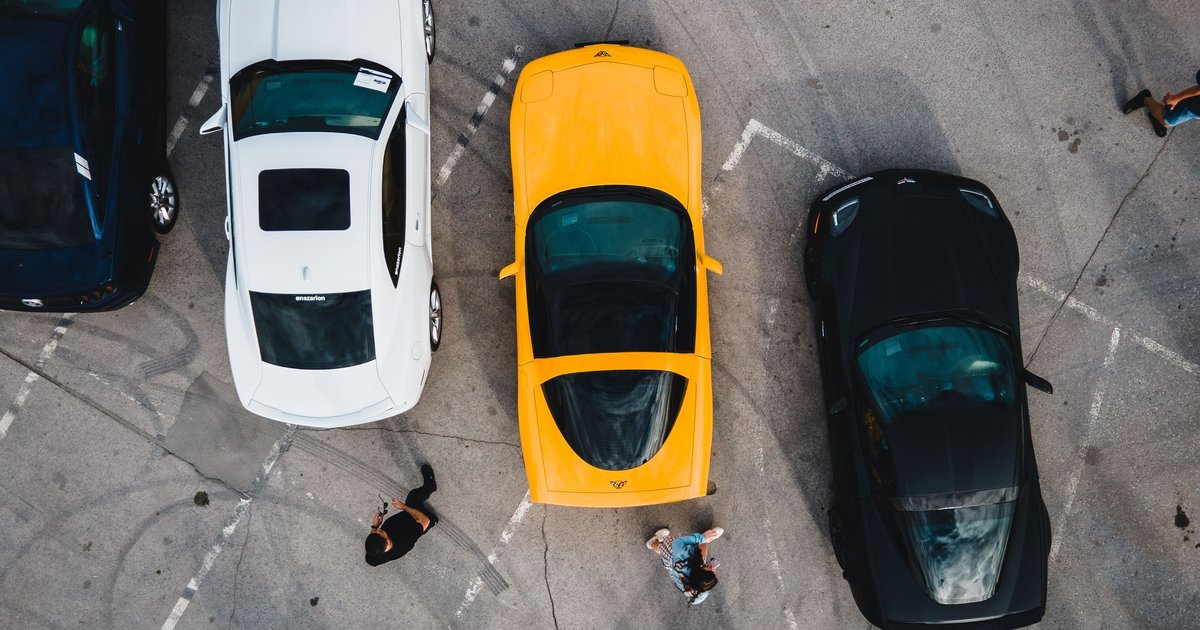
- Park inside the lines. Center your car in the space. Drifting over a line can cost the next driver the spot.
- Never take two spots. A new car doesn't earn extra space. If you're worried about dings, park at the far end of the lot.
- Leave door room. Before you walk away, check that your neighbor can fully open a door, especially if there's a car seat inside.
- Open your door with care. Keep a hand on it, above all on windy days. A small ding is still someone else's repair bill.
- Never block a driveway. Not even "for one minute." You can't know who needs to leave, or how urgently.
- Keep clear of hydrants, crosswalks and curb ramps. Firefighters, wheelchair users and parents with strollers all depend on them. Required distances vary, so read the signs.
- Leave accessible spots and their striped aisles alone. No permit means no parking, however short the stop. The aisle is what makes room for a ramp or wheelchair.
- Use EV chargers only to charge. Move your car when the session ends so the next driver can plug in.
- Don't idle in pickup or fire lanes. If you'll be more than a moment, find a real space and walk.
- Pull through only when it's clear. Make sure the spot ahead is empty and no one is about to turn into it.
- Respect whoever got there first. A driver with a turn signal on and waiting has claimed that spot.
- Don't save spots on foot. Standing in a space to hold it for a friend puts you in the path of moving cars.
- Drive slowly and watch for people. Kids and shoppers step out from between cars.
- Return your cart. Loose carts roll into cars and take up spaces.
- If you cause damage, own up. Find the owner or leave your contact details. Driving off makes a small problem much bigger.
Parking lot etiquette
Grocery and retail lots
Spots near the door matter most to people who can't walk far, so take a farther one if you can. Treat family and expectant-parent spots as a courtesy to those drivers, even where no rule is enforced. Once you've unloaded, take your cart to the corral rather than wedging it on a median.
Parking garages
Garages are tight, so follow the arrows and take ramps slowly. Check for pillars before you open your door, and don't let your bumper hang into the driving lane. Have your ticket or payment ready before you reach the exit gate, so the line behind you keeps moving.
Waiting for a spot
The rule is first come, first served. Put your turn signal on and stop far enough back for the departing driver to reverse. And if another driver snatches your spot? Let it go. No parking space is worth a fight.
Street and residential parking etiquette
Neighbors and driveways
Leave a few feet on each side of a driveway so your neighbors can see traffic as they back out. If a neighbor's habit bothers you, talk early and in a friendly tone, while it's still a small thing.
Parking in front of someone's house
On a public street, the curb usually isn't reserved for the person who lives there, unless signs or permits say otherwise. Still, don't leave a car in one neighbor's frontage for days at a time, and keep clear of trash bins on collection day. A quick heads-up goes a long way if you're hosting guests.
Alternate-side and street-sweeping days
Read the signs on your block and set a reminder, since schedules change by city and season. Move on time, and don't double-park in a way that traps another car.
Special spots
Rules for these spaces vary by state and city, so treat this as general guidance and follow the posted signs.
Accessible spots
These spaces and their access aisles exist so people with disabilities can reach a building. ADA.gov explains what accessible parking requires, and your state DMV sets the permit rules. California's DMV placard page is one example. Not every disability is visible, so don't confront a driver. Report misuse of a handicap spot instead.
EV chargers
Don't park at a charger unless you're charging, and move once you're done. Some places ticket or tow cars that overstay, so check the signs.
Compact-only spaces
If your truck or SUV hangs over the lines, it isn't compact. Keep looking.
Motorcycle spots
Cars should stay out, even when a space looks wasted.
Loading zones
These are for active loading, often with a posted time limit, and some are commercial only. Waiting for a friend doesn't count as loading.
What to do when someone breaks the rules
Stay calm, stay safe, and never touch or damage the other car. If a car is an urgent hazard, call local enforcement.
Someone is blocking your driveway
- Give it a few minutes and look around. It may be a delivery driver or a neighbor's guest.
- Take a photo showing the car and your blocked driveway.
- Leave a polite note, or a message by plate.
- If you need to get out, call parking enforcement or the police non-emergency line. Here's the full guide to what to do when someone is blocking your driveway.
Don't know the owner? Send them a message by license plate on PlateQuery.
Someone is parked in your spot
- Double-check the spot number. Mix-ups are common, especially with new neighbors.
- Take a dated photo of the car in the space.
- Tell your landlord, HOA or property manager, who usually controls towing on private lots. Here's what to do when someone parks in your spot.
- Park somewhere legal in the meantime, and don't box the other car in.
Don't know the owner? Send them a message by license plate on PlateQuery.
A car's lights are on or a window is open
- Check it's really a problem. Many cars switch their lights off on their own after a short delay.
- Don't reach inside or try the doors, even to help.
- If you're at a store or office, ask the front desk to page the driver.
- Tuck a short note under the wiper so the driver sees it on return.
Don't know the owner? Send them a message by license plate on PlateQuery.
Someone hit your parked car
- Photograph the damage, the scene and any nearby cars, and note the date and time.
- Look for a note, witnesses and security cameras nearby.
- Contact the police if local rules call for a report, then call your insurer.
- If you have the other car's plate, give it to them. They can act on it in ways you can't. See what to do when someone hits your parked car.
Saw it happen to someone else's car? Leave a note with what you saw. Don't know the owner? Send them a message by license plate on PlateQuery.
A car seems abandoned
- Look for signs: flat tires, thick dust, expired tags or flyers piling up.
- Note the location and how long it's been there, and take a photo.
- Try reaching the owner, who could simply be traveling or in the hospital.
- Then report the abandoned vehicle to your city. Different rules apply to abandoned vehicles on private property.
Don't know the owner? Send them a message by license plate on PlateQuery.
Is it OK to leave a note on someone's car?
Yes, leaving a note on a car is fine if it's polite and doesn't touch the paint. Tuck it under a wiper and skip tape or stickers.
- Pros: it's quick, it needs no app, and the driver sees it the moment they return.
- Cons: it can blow away or get soaked, an angry tone can make things worse, and you have to approach the car.
Three short templates you can copy:
Hi! Your headlights were on when I walked by around 2 p.m. Just a heads-up so your battery doesn't die.
Hi, you're parked close to my driver's door and I had trouble getting in. Could you leave a little more room next time? Thanks!
Hi, your car is partly blocking my driveway and I need to leave by 5 p.m. Could you please move it? Thank you!
Messaging by plate is often the safer choice. There's no face-to-face confrontation, and your message can't blow away. It stays on the plate's page, where the owner can find it later.
How to contact a car owner by license plate
As a member of the public with a parking problem, you can't legally get a car owner's name or address from their plate. The federal Driver's Privacy Protection Act limits who can access DMV records and why. Here's what a plate lookup can legally tell you. You can, however, leave them a message:
- Look up the plate. Go to the license plate lookup, choose the state and enter the plate number. You can also browse plates in California, Texas, Florida and every other state.
- Leave a message. Say what you saw, when, and roughly where. Messages are public, so leave out personal details. Guests confirm by email; registered users skip that step.
- The owner gets an alert. We review each message before it appears. Then owners who have claimed or follow that plate are notified.
PlateQuery never shows an owner's name or address. Our guide to contacting a vehicle owner covers your other options.
Got a message about your parking?
Don't take it personally. Most messages are a heads-up from someone nearby. Check your car, move it if you need to, and post a short, friendly reply on your plate's page if you'd like.
To hear about future messages, follow your plate for free. If you'd rather keep things out of public view, you can claim your license plate and go private with a paid subscription, which hides its messages from the public page. Want people to reach you more easily? A QR code sticker lets anyone scan your windshield and leave a message. See our FAQ for more.
FAQ
Is it rude to park in front of someone's house?
Usually not, if it's a public street with no permit rules. It can feel rude if you stay for days, crowd a driveway or block trash bins. For long stays or big gatherings, a quick word with the neighbor prevents most hard feelings, and it costs you nothing.
Can I block someone who blocked me?
Please don't. Boxing in another car can escalate the conflict, trap someone with an emergency and may put you in the wrong with local parking rules. Take a photo, try to reach the driver, and call parking enforcement or your property manager to handle it instead.
How long can a car stay parked on a residential street?
It varies by city. Many places limit how long a car can sit in one spot without moving, and permit zones and street sweeping add their own rules. Check your city's website or call its parking office for the limit where you live, since signs don't always show it.
Can I find out who owns a car from its license plate?
Generally not. DMV records are protected by federal privacy law, and a parking dispute isn't a qualifying reason to access them. Police and insurers can act on a plate after a crash. You can still leave a message for the owner by plate on PlateQuery, without seeing any personal details.
What should I do if someone parks too close to my car?
If you can't get in the driver's side, try the passenger door or the trunk, or wait a few minutes for the driver to return. Take a photo if you're worried about damage. A polite note or message may stop it from happening again, especially if it's a neighbor.
Can I have a car towed from my spot?
It depends on who controls the property. In an apartment or office lot, the landlord or property manager usually has to authorize a tow under local rules. On your own property, call local enforcement first and ask what's allowed, because improper towing can leave you responsible for the costs.
The short version
Park as if the next driver is your neighbor, and when someone doesn't, start with a polite message.