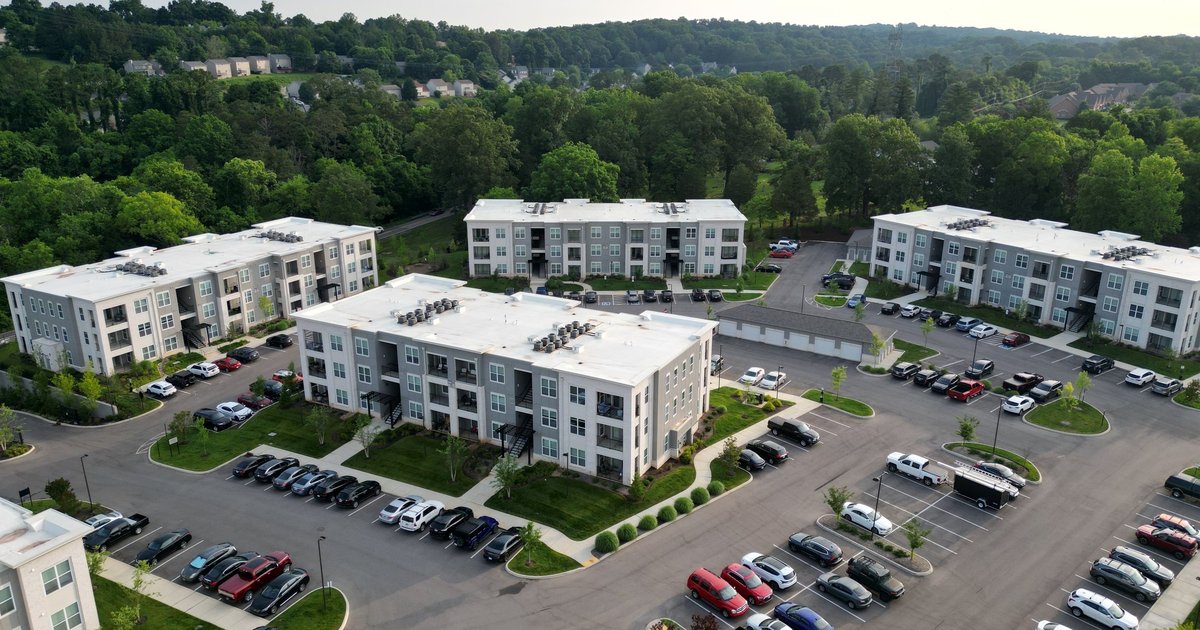
Every HOA board and apartment manager knows the parking complaints: a stranger in a resident's assigned spot, a "guest" car that hasn't moved in three weeks, hang tags passed between friends, and a binder of vehicle records nobody trusts. HOA parking management software replaces the stickers, spreadsheets and guesswork with one system built around the thing every car already carries: its license plate.
This guide explains what parking management software for HOAs and apartment communities does, what to look for before you buy, how a plate-based system works day to day, and how to roll it out without a revolt at the next board meeting.
What is HOA parking management software?
Parking management software is a single place to record who is allowed to park on your property, where, and until when, and to act when a vehicle doesn't belong. For a homeowners association, condo association or apartment community, that usually means five jobs:
- A vehicle registry: every resident, staff and guest vehicle, tied to a unit and a contact.
- Permits: who may park, at which location, from which date to which date.
- Spaces: assigned, reserved, visitor, accessible and EV spaces, and which vehicles belong in each.
- Enforcement: checking a car on patrol, then documenting warnings and violations with photos.
- Communication: reaching the driver, and announcing lot closures, repaving or snow removal to everyone who parks with you.
Older systems do this with paper: hang tags, window decals, a clipboard on patrol and a phone tree. Modern systems do it digitally, and the best ones key everything to the license plate rather than a sticker.
Why plate-based parking permits beat stickers and hang tags
A sticker or hang tag is a separate object from the car. It gets lost, transferred to a friend's car, photocopied, or left on the dashboard of a car that moved out months ago. Every one of those failures turns into an argument when someone gets warned or towed.
A license plate parking permit (also called a virtual or digital parking permit) lives in the system, attached to the plate. There is nothing to print, mail or replace, and nothing to share. When a permit ends, it ends: the car's status changes automatically, with no tag to collect.
- No more sharing or copying: the permit belongs to one plate, not to whoever is holding the tag.
- Instant changes: a new car, a new unit or a revoked permit takes effect the moment it's saved.
- Faster patrols: staff check a plate instead of squinting at a mirror for a tag.
- A clean record: every permit, warning and violation is tied to the same plate, so repeat offenders are obvious.
Before you switch, read your governing documents. Some older CC&Rs and parking rules name a physical decal or hang tag as the proof of permission to park. If yours do, the board may need to amend the parking rules before plate-based permits become the official standard. Your association's attorney can tell you what the change requires.
Features to look for in parking management software
Most vendors cover the basics. These are the questions that separate a tool your staff will actually use from one that ends up abandoned after the first month.
1. A vehicle registry you can trust
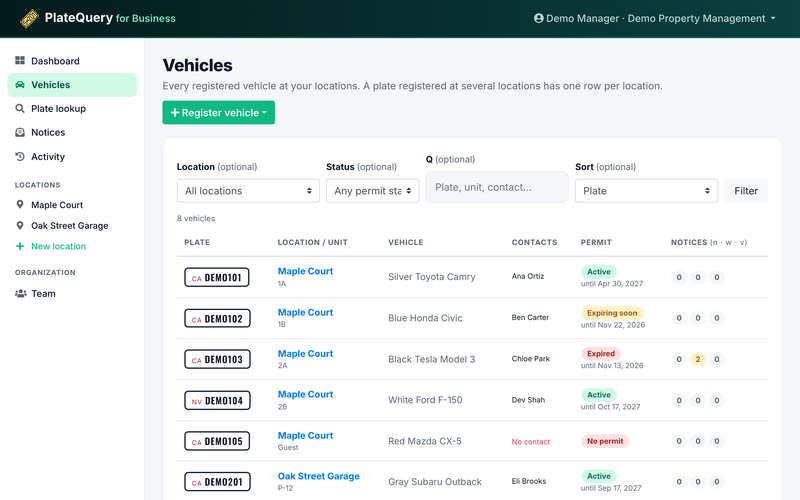
Look for one record per vehicle per location: plate and state, make, model and color, unit, and one or more contacts. You should be able to bulk import your existing roster from a CSV file instead of typing it in, and export it again whenever the board asks. Families with two cars sharing two spaces, and residents who park at more than one of your properties, should be easy to represent.
2. Digital permits with real start and end dates
Permits need types (resident, staff, guest, contractor), a start date and an end date. The system should show at a glance which permits are active, expiring soon, upcoming or expired, and remind residents before a permit lapses so your office isn't the one chasing renewals.
3. Space and floor maps
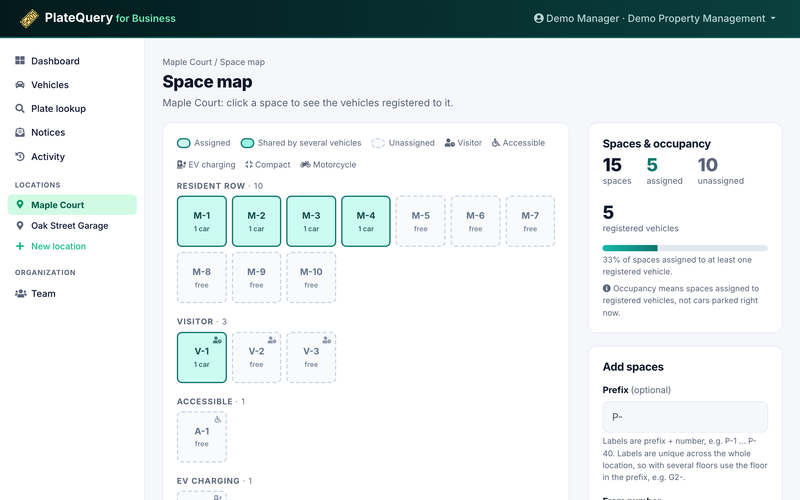
Assigned parking creates disputes only when nobody can prove who a space belongs to. A space map with your real layout, from a single surface lot to a multi-level garage, lets anyone on your team click a space and see the vehicles assigned to it.
4. Mobile plate lookup for patrols
Enforcement happens in the lot, not at a desk. Your staff, security or patrol company should be able to type a plate on their phone (or photograph the car and have the plate read for them) and immediately see whether it belongs: registered or not, permit status, unit, and its history of warnings and violations.
5. Warnings and violations with photo evidence
Every enforcement action should be documented: the kind of notice (a friendly notification, a warning, or a violation), the reason (no permit, expired permit, reserved space, fire lane, accessible space without a placard, time limit, abandoned vehicle), photos, and a timestamp. Documented, consistent enforcement is what holds up when a resident disputes a tow.
6. A way to reach the driver
This is where most parking tools stop short, and where the biggest difference between products is. More on it below.
7. Roles, location access and an audit trail
A property manager, an on-site staff member and a third-party patrol need different access. Multi-site portfolios need managers who only see their own properties. And every permit, notice and change should land in an activity log you can export for board meetings and audits.
How plate-based parking management works day to day
Here is what a typical week looks like with a plate-based system such as PlateQuery for Business:
- Set up once. Add your properties, floors and spaces, then import residents and their vehicles from a spreadsheet.
- Issue permits. Resident, staff, guest and contractor permits are attached to plates with start and end dates. Residents get a reminder before theirs expires.
- Patrol. Staff look up a plate on their phone, or snap a photo of the car to fill it in. The result shows whether the car is registered at that location, its permit, its unit and its history.
- Enforce consistently. If a car doesn't belong, staff record a notification, warning or violation with photos. Repeat offenders are flagged automatically.
- Communicate. Registered contacts are emailed about notices that concern their vehicle, and managers can send announcements to everyone at a location when the lot is closed for repaving or snow removal.
- Report. The dashboard shows vehicles by permit status for each location, and the activity log can be exported for the board.
Reaching drivers who aren't registered with you
Every parking system can contact the people already in its database. The hard cases are the cars that aren't: a visitor in a resident's assigned space, a car blocking a gate, a vehicle nobody recognizes that has been sitting in the guest row all week. Traditional tools leave you two options for those: a note on the windshield, or the tow truck.
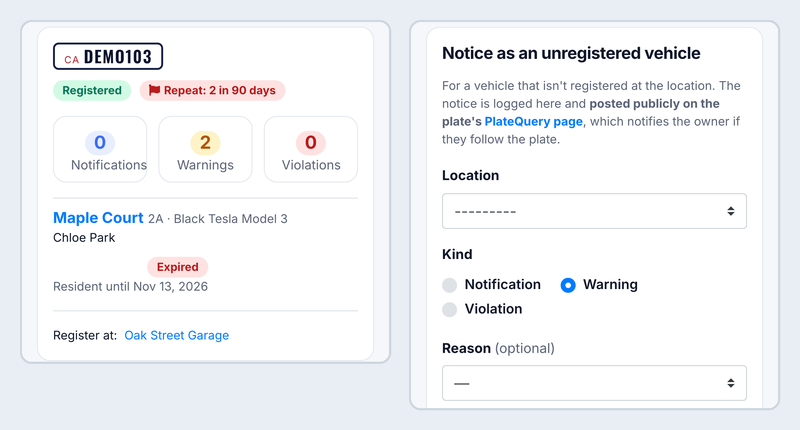
PlateQuery adds a third. It is also a public network where drivers claim their own license plate and follow it, so they are emailed when someone posts about their car. When your staff record a notice for an unregistered vehicle, it can be posted on that plate's PlateQuery page, which notifies the owner if they follow the plate. Anyone can also look up a plate and message the owner the same way.
That gives a driver a chance to move the car before it becomes a tow, a dispute or a bad online review, and it gives you a documented record that you tried. When towing is still necessary, follow your state's private-property towing rules and your own governing documents; our guide to when and how vehicles get towed covers the basics.
Want to see it with your own lots? Request a PlateQuery for Business demo and we'll set it up around your properties, spaces and parking rules.
Who uses parking management software
- HOAs and condo associations that enforce parking rules written into the CC&Rs, with volunteer boards that need records they can defend.
- Apartment and multifamily communities with assigned spaces, guest parking and constant move-ins and move-outs.
- Property management companies running several communities, each with its own rules and staff.
- Universities, schools and corporate campuses with staff, student and visitor permits.
- Hospitals, hotels and mixed-use buildings where reserved, visitor and accessible spaces have to stay available.
If your residents' main complaint is illegal parking in the apartment complex or someone parking in their assigned spot, those are exactly the problems a plate-based registry and consistent enforcement solve.
How to roll out a new parking system in your community
- Check your rules. Confirm your CC&Rs, lease terms and posted signage allow plate-based permits and describe how violations are handled.
- Clean up your roster. Export what you have, even if it's a spreadsheet, and import it. Missing vehicles will surface during the first patrols.
- Announce the change early. Tell residents how permits work now, what happens to the old tags, and when enforcement starts. A grace period of a few weeks with friendly notifications instead of warnings keeps goodwill.
- Train the people who patrol. A five-minute walkthrough of the plate lookup on their phone is usually enough.
- Enforce the same way every time. Use the same reasons and the same escalation, notification then warning then violation, so nobody can claim they were singled out.
- Review monthly. Look at expired permits, repeat offenders and where violations cluster, and adjust your rules or signage.
Good parking habits help too. Our parking etiquette guide is a handy link to include in your resident newsletter, and residents who want to know what to do about abandoned vehicles on private property will find the steps there.
Frequently asked questions
What is the best parking management software for an HOA?
The best HOA parking management software is the one your board and staff will actually use: plate-based permits instead of stickers, a mobile plate lookup for patrols, documented warnings and violations with photos, and a reliable way to reach drivers. Check whether the tool can contact drivers who aren't registered with you, because those cars cause most disputes.
Do we still need parking stickers or hang tags?
No. With plate-based permits, the permit is tied to the vehicle's license plate, so staff verify a car by looking up its plate. Some communities keep physical tags during a transition, and some governing documents require a rules change before tags can be dropped.
How do guest parking permits work without hang tags?
A guest permit is attached to the visitor's plate with a start and end date, just like a resident permit. When it ends, the car's status changes to expired automatically, so there's no tag to collect and no pass to reuse.
Can we notify a driver who isn't registered with us?
With PlateQuery, yes. A notice for an unregistered vehicle can be posted on that plate's public PlateQuery page, and owners who follow their plate are notified by email. Most parking systems can only contact people already in their own database.
Is plate-based parking enforcement legal?
Recording license plates that are visible on your own property is common practice for parking enforcement. What you must follow are your state's private-property towing and signage rules and your community's governing documents. Ask your association's attorney if you're unsure.
How long does it take to set up?
It depends on your property. PlateQuery for Business onboards a limited number of organizations at a time and sets up properties, spaces, permit types and your resident import with you, so your team isn't left configuring it alone.
See PlateQuery for Business in action
PlateQuery for Business gives property managers, HOAs and campuses one place to run their parking: spaces, vehicles, digital permits, patrols, violations with photo evidence, and a way to reach the driver even when they never registered with you. It's invitation only while we onboard communities one at a time.
Request a demo and we'll walk you through it with your own lots and rules, or see everything PlateQuery for Business does.