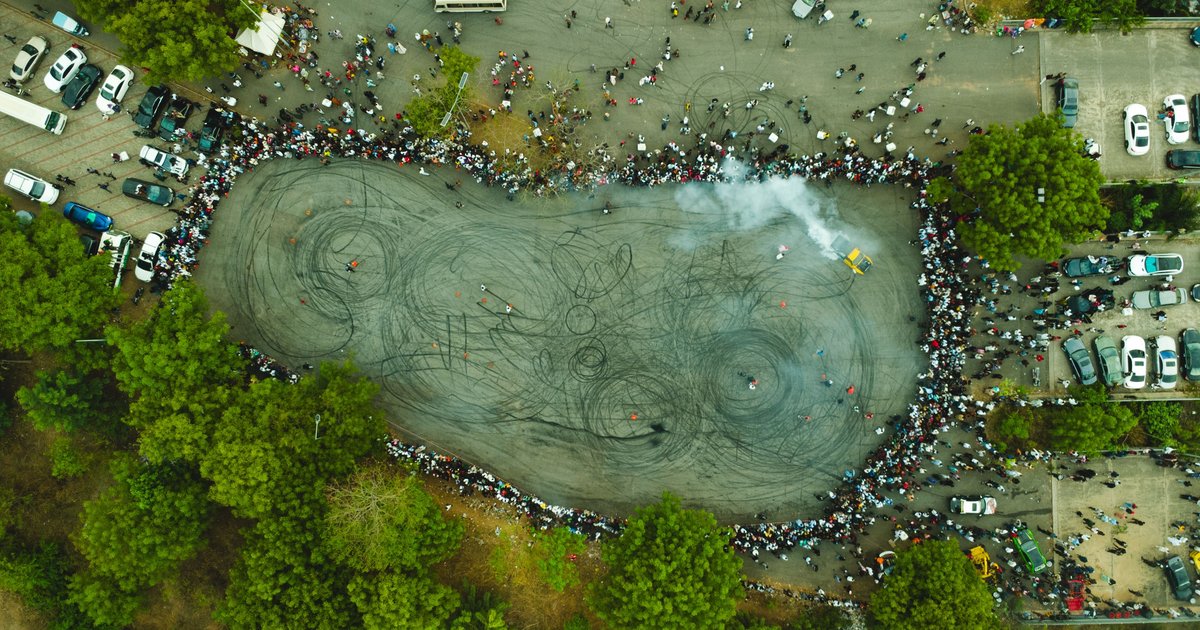
Is it illegal to drift in a parking lot?
In nearly every state, the answer to is it illegal to drift in a parking lot is yes. Private parking lots — grocery stores, strip malls, office complexes, apartment garages — are considered areas generally open to the public, which means most state traffic codes still apply there. On top of that, police and prosecutors can reach for reckless driving, exhibition of speed, or newer anti-street-takeover statutes that specifically target sliding, burnouts, and donuts.
The idea that "it's private property, so the rules don't apply" is one of the most common myths in car culture. In reality, the owner of the lot didn't give you permission to drift there, and even if they did, state law usually still governs reckless operation of a motor vehicle in any place the public can access.
The laws that typically apply
Most drifting-in-a-lot cases get charged under one or more of these buckets:
- Reckless driving — operating a vehicle with willful or wanton disregard for safety. Intentionally breaking traction in a space where pedestrians and parked cars exist fits this description almost by definition.
- Exhibition of speed or "speed contest" — many states criminalize demonstrating acceleration, power, or tire-spinning for show, regardless of how fast you're actually going.
- Street takeover / sideshow laws — a growing number of states (California, Texas, New York, Georgia, and others) have passed statutes in the last few years specifically aimed at drifting, donuts, and burnouts in intersections and parking lots. Penalties can include vehicle impound.
- Trespassing — if the lot owner hasn't authorized you to be there after hours, that's a separate charge on top of the driving offenses.
- Property damage — tire marks, damaged curbs, torn-up landscaping, and scorched asphalt can all become civil or criminal restitution claims.
California: the state that wrote the book on sideshow laws
California is worth calling out because its approach is distinctive. The California Vehicle Code has long banned exhibitions of speed and speed contests on highways — and, importantly, the definition of "highway" and "offstreet parking facility" in the code sweeps in parking lots open to the public. A 2021 law (AB 3) specifically expanded sideshow penalties, and subsequent updates have given courts the authority to suspend the driver's license of someone convicted of participating in a sideshow or street takeover, which often involves drifting in lots.
Enforcement is handled by local police and the California Highway Patrol, and the DMV (dmv.ca.gov) handles the license consequences after a conviction. Exact fine amounts, impound durations, and suspension lengths change — confirm current figures through the CHP or the DMV rather than relying on older forum posts.
Texas, Florida, and the "street racing" crackdowns
Texas treats racing on a highway as a serious offense under the Transportation Code, and courts have repeatedly applied it to parking-lot exhibitions. The Texas Department of Public Safety (dps.texas.gov) is the state agency involved, but most charging decisions come from local police and county DAs.
Florida tightened its anti-street-racing law in recent years to explicitly cover "stunt driving" and spectator liability — meaning even watching a drift session in a parking lot can expose you to a citation. The Florida Highway Safety and Motor Vehicles department (flhsmv.gov) is the agency to check for current penalty structures. New York passed similar sideshow legislation, and Georgia's HB 534 made participating in or organizing a street racing or drifting event a felony on a repeat offense.
If you're trying to figure out the exact rule where you live, don't rely on a generic blog — look up your state's vehicle code and your city's municipal ordinances, which often add their own layer.
What property owners and managers can do
If you own or manage a lot where people keep showing up to drift, you have several options beyond calling 911 in the moment:
- Signage — posting "No trespassing after hours," "No stunt driving," and "Violators will be towed" signs strengthens any later trespass or towing action.
- Physical deterrents — bollards, speed bumps, planters, and gates break up the open space drifters need.
- Cameras and plate capture — recording the plate numbers of offending vehicles gives police something to work with even after the drivers leave.
- A plate-based reporting workflow — tenants, security, and neighbors can note a plate and report it rather than confronting an angry driver.
For managers of apartment complexes, HOAs, and commercial lots, this is a chronic problem. Our guide to HOA and apartment parking management software covers how to build a plate-based system for repeat issues, and PlateQuery for Business is built for exactly this kind of use case.
What if someone is drifting where you live?
If it's happening right now and there's any risk of injury, call 911 — this is a moving-vehicle safety issue, not a parking complaint. If you want to report a pattern (every Saturday night, same cars), contact the non-emergency line and ask whether your department has a street-racing or sideshow task force; many urban departments now do.
If you caught a plate, write it down along with the date, time, and a description of the vehicle. You can also check that plate on PlateQuery — the public page will show which agencies have recently looked that plate up through Flock Safety's camera network (when such records exist from public-records releases), which can give you a sense of whether law enforcement is already tracking the vehicle. For the broader etiquette side of lot behavior, our piece on parking etiquette and how to handle bad parkers is a good companion read, and the illegal parking topic hub covers related situations.
FAQ
What if the parking lot is completely empty?
Still illegal in most states. Reckless driving and exhibition-of-speed laws don't require a victim or a witness — they require the conduct itself in a place the public can access. An empty 3 a.m. Walmart lot still qualifies.
What if the property owner gave me permission?
Written permission from the owner can defeat a trespass charge, but it generally does not override state traffic laws that apply to parking lots open to the public. The safer path is a closed course, an autocross event, or a drift day at a racetrack — venues set up with insurance, run-off areas, and legal cover.
Can my car get impounded?
In many states, yes — especially under newer sideshow statutes in California, New York, and Georgia. Impound periods can be lengthy, and getting the vehicle back often involves fees and proof of registration and insurance.
Does it matter if I didn't damage anything?
Not really. The offense is the conduct, not the result. Damage just adds restitution on top.
The practical takeaway
Drifting in a parking lot is one of those things that feels like a gray area and almost never is — it's illegal in nearly every state, often under multiple overlapping statutes, and the legal consequences have gotten stiffer, not softer, over the last few years. If you want to drift, do it at a sanctioned event. If you're on the receiving end — a resident, a property manager, a neighbor losing sleep — get the plate.
Once you have a plate number, look it up on PlateQuery to leave the driver a message, see what public ALPR lookup history exists for that vehicle, and build a record you can share with police or property management. Here's a real example of what a plate page looks like. And if you want to stay on top of your own vehicle's profile, create a free PlateQuery account and get notified any time someone messages your plate.